Car-free villages in Switzerland and how to reach them by public transport
Anyone arriving in a car-free village often notices after a few steps that something is missing. There are no engines, no hunting for a parking space and no through traffic. What you hear are footsteps, cowbells and a stillness such as the Alps knew before the roads were built. Switzerland has preserved a whole series of such places. Each of them can be reached only by mountain railway, train or boat. The journey thus becomes a small experience in itself, while the village becomes a retreat. Our overview begins with the two villages in our own region.
The Stoos: arriving on the steepest funicular in the world
Reached by: the steepest funicular in the world (110 %) from Schwyz or the cable car from Morschach · ~1 h 30 from Lucerne
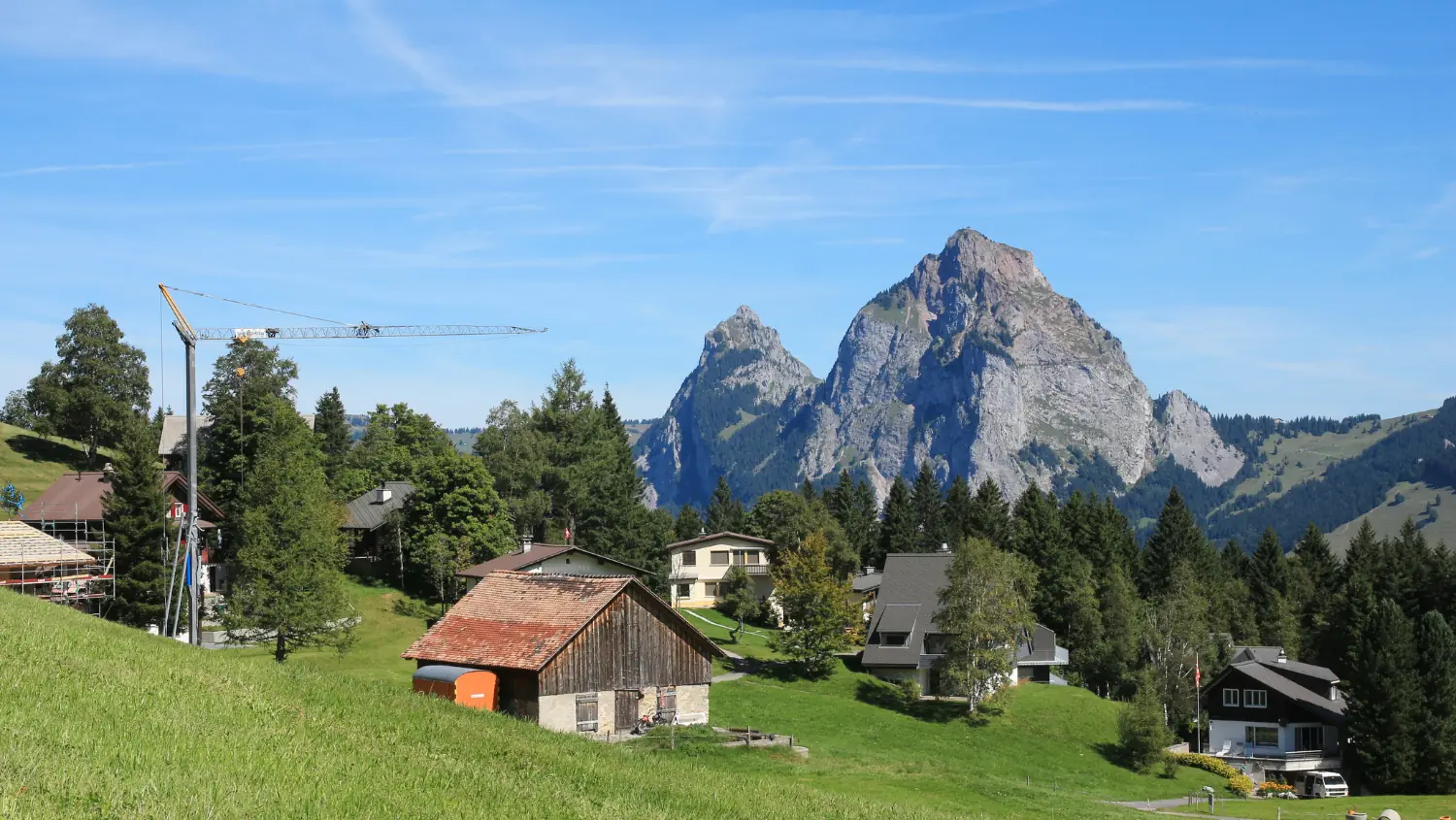
The Stoos lies right on our doorstep. Hardly any car-free village has such a striking approach. For seven minutes the funicular climbs steeply to a sunny plateau at 1300 m. Up top children can move freely along the paths, and the luggage travels by electric cart. In summer the well-known ridge walk and the paths across the plateau beckon; in winter 35 kilometres of pistes and quiet evenings in the village. The Stoos shows nicely what the absence of cars does: even on busy days the village stays calm, because no traffic rolls through the lanes. More about the Stoos: Stoos Ridge Hike, Stoosbahn: Riding the World's Steepest Funicular and Stoos in winter.
Rigi Kaltbad, the car-free village with the mineral bath
Reached by: cable car from Weggis or rack railway from Vitznau/Arth-Goldau · ~1 h from Lucerne
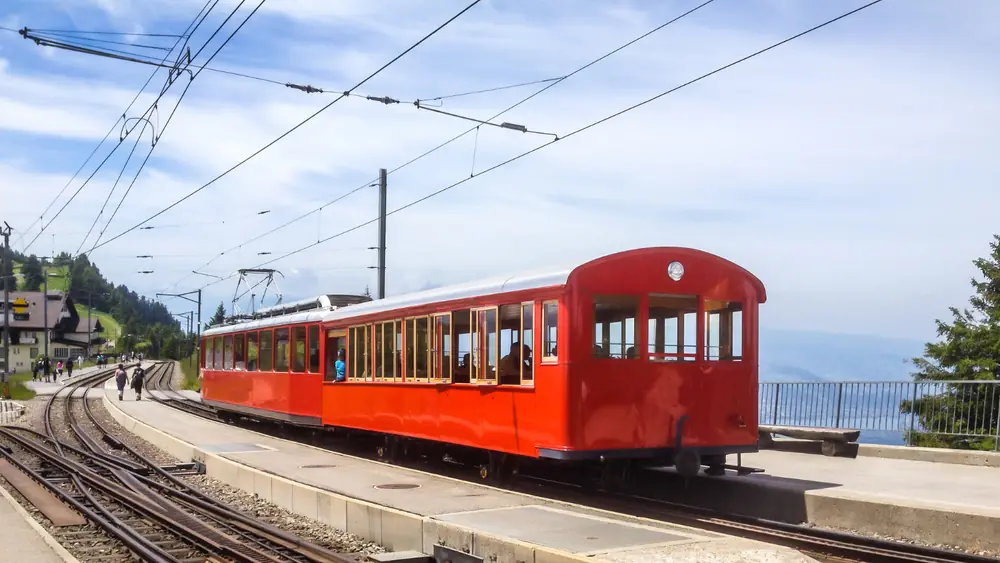
As a car-free village, Rigi Kaltbad is less well known, because the railways here seem so natural. The mountain village halfway up the Rigi has lived from the railway since 1871. Back then came the guests of the Belle Époque; today the mineral bath by Mario Botta is an important draw. There you bathe in the open high above the lake, in a village where not a single car drives. More on this: Rigi: The Guide to the Queen of the Mountains and Mineralbad & Spa Rigi Kaltbad.
The famous classics for a longer trip through Switzerland
- Zermatt is the big name among car-free villages and lies at the foot of the Matterhorn. Electric taxis hum through the lanes and all guests arrive by train.
- Wengen and Mürren lie like two balconies in the Jungfrau region. They are reached by train and cable car and have largely kept their character for a hundred years.
- Braunwald is the sun terrace of the Glarus region and is reached by funicular. Lying just east of our region, it is a good tip for anyone seeking quiet.
- Riederalp and Bettmeralp lie above the great Aletsch glacier and can be reached only by cable car.
- Gimmelwald, Saas-Fee and others: car-free villages exist throughout the Alps. The pattern is similar everywhere: the railway takes you up and at the top you can breathe.
(For a journey through Central Switzerland, the Stoos and Rigi Kaltbad offer the same experience without the long transfers the big names require.)
Why a car-free village changes the visit
- Children can move freely. Parents who have hardly let go of their children's hands since the airport visibly relax on the village square of the Stoos.
- The sounds of the mountains come back. You hear cowbells, the hum of the chairlift and the conversations at the tables. Along roads these sounds have long since disappeared into the traffic noise.
- The journey becomes part of the experience. Whether funicular, boat or rack railway, the ride is already the first attraction and not merely a stretch to be got over.
- The evenings belong to the guests. With the last trains the day visitors go down to the valley. Anyone staying overnight in the village then has it almost to themselves.
- Being car-free is everyday life here. These villages are not museums. People live, work and go to school here, and they are supplied by the same railways on which you arrive. That no cars drive is a practical tradition, not the theme the villages advertise with.
Practical points
- Luggage: the hotels organise transport from the valley station, on the Stoos with electric carts. Even so, pack so that you can roll or carry the last stretch.
- Travelcards: the GA travelcard and the Swiss Travel Pass are valid on the funicular to the Stoos, on all the Rigi railways and on the boats connecting to them. With such a card the round of the car-free villages is thus almost fully covered. All the details: Swiss Travel Pass, GA and half-fare card in the Schwyz region.
- Last departures: the last train decides how long your day lasts. Note the evening departure times, especially in the low season when the timetables are thinner.
- Winter access: both villages in our region can be reached all year. That reliability is a large part of their appeal. More on winter: Stoos in winter and The Rigi in winter.
Frequently asked questions
Which Swiss villages are completely car-free? Among the best known are Zermatt, Wengen, Mürren, Saas-Fee, Braunwald as well as Riederalp and Bettmeralp. In Central Switzerland they are the Stoos and Rigi Kaltbad.
How do you reach the Stoos without a car? You take the train to Schwyz, bus 501 to the Stoos funicular and then the steepest funicular in the world up the slope. Alternatively you take the boat and bus to Morschach and ride the cable car to the Stoos from there. All the variants in detail: Getting to Stoos from Lucerne and Zurich.
Can you stay overnight in car-free villages? Yes, and an overnight stay is especially worthwhile, because after the last departures the villages grow quiet. The hotels take care of the luggage from the valley station.
Is travelling without a car practicable in Switzerland? Yes, very much so, because the public transport network is designed for exactly that. With a GA travelcard or a Swiss Travel Pass you travel the whole round on a single ticket.